When Africa feeds the algorithms: towards local, efficient and sovereign AI
04 February 2026
538
For years, Africa has been underrepresented in global datasets. The result: algorithms that poorly understand African realities – its languages, climates, farming practices, health risks and payment behaviors.
According to GIZ, African datasets remain minimal in model training (a recurring issue documented by the AI Made in Africa initiative). In other words: a billion humans hardly participate in building models that influence global health, finance, agriculture and public policy, creating biases and local underperformance.
But change is happening. Africa is beginning to produce, host, and leverage its own data in AI-ready regional data centers, interconnected and energy-efficient. The continent is gradually powering algorithms and starting to influence how AI understands the world.
Specifically, deployments on regional clouds reduce p95 latency by about 45%, lower TCO per 1,000 requests by 25–35% and raise SLAs to 99.9% – three direct levers of time-to-value.
Africa, the next hub of the data economy
Value now comes not just from megabits but from useful bytes: mobile transactions, agricultural remote sensing, climate sensors, medical imaging, multilingual corpora, industrial logs, urban mobility.
- Cables (2Africa, Equiano), fiber, and 4G/5G lay the transport layer.
- Regional data centers and sovereign cloud establish the execution and trust layer.
- African datasets (open and sectoral) form the intelligence layer.
This trajectory aligns with the African Declaration on AI (Kigali, 2025), promoting an Africa AI Fund and an African AI Council to strengthen local datasets (C4IR Rwanda – PDF).
Meanwhile, the Pan-African Parliament (July 25, 2025) includes data sovereignty and responsible AI in its legislative agenda, preparing a future continental model law.
From “data extraction” to “data empowerment”: a paradigm shift
For a long time, African data was treated as a raw resource: extracted, exported, used elsewhere.
The new model reverses this logic:
- Local residency of sensitive data (e.g., Kenya DPA/ODPC; Nigeria NDPA)
- Proprietary pipelines: startups build their own metrics, feature stores and field feedback loops
- Sovereign infrastructures: colocation, regional cloud, multi-operator interconnection and end-to-end security
The Africa’s Digital Sovereignty Trap analysis (New America, 2025) shows that pitting sovereignty against growth is a false choice: smart localization + regional coordination (interoperability) = performance + sovereignty.
Digital sovereignty is not isolation; it is expansion a continent choosing to control its data to shape its own intelligence.
This vision aligns with the African Union 2025–2030 Digital Strategy, placing data at the heart of sustainable development and global competitiveness.
Three pillars of efficient African AI
African, open and representative datasets
Through the AI Made in Africa initiative, led by GIZ and the African Union, more than 180 public datasets now cover agriculture, health, finance, education and local languages. These open datasets provide contextualized training data, aligned with continental realities a crucial foundation for developing fairer, inclusive and high-performing AI models.
Thriving Pan-African AI communities
This revolution is not only institutional; it is community-driven. Collectives like Masakhane, specializing in African language NLP and Zindi, an open AI competition platform, bring together researchers, engineers and students to make AI African by design.
Every project and locally trained model strengthens skills, trust and technological independence across the continent.
AI-Ready infrastructure to bring data closer to compute
The Olkaria geothermal data center in Kenya, a partnership between Microsoft and G42, exemplifies the convergence of performance, sovereignty and sustainability: an architecture designed to keep intelligence African, within its data flows, models and benefits.
These three pillars (open data, engaged communities, sustainable infrastructure) are interlinked: they form the matrix of a continent producing intelligence. Where Africa once exported its raw resources, it now begins to export knowledge.
Real-world use cases: agriculture, health, fintech
African data is no longer just an indicator; it is a strategic lever transforming how the continent farms, heals, and finances. In each sector, the principle is the same: keeping data local creates value, trust and performance.
Agriculture and climate: data for resilience
In rural Kenya, connected sensors and mobile apps collect agricultural and weather data, hosted in AI-ready regional data centers. These flows feed predictive models anticipating droughts and optimizing planting.
Apollo Agriculture (Kenya), cited by Lanfrica, shows measurable gains: –15% input usage, +10% yield, –25% post-harvest losses. Locally hosted predictive models adjust inputs and reduce losses – a clear proof that African data generates useful, sustainable intelligence.
Health and inclusion: finally representative research
Initiatives like 54Gene (Nigeria) create African genetic databases correcting decades of medical bias. By integrating continental diversity, these projects improve diagnosis and therapeutic accuracy.
Each analyzed sample advances collective science – recognizing African plurality (Nature Africa, Frontiers).
Finance and digital economy: trust through proximity
By localizing hosting, companies like Flutterwave and MFS Africa now process KYC and anti-fraud operations in real time. This proximity reduces latency, simplifies compliance (NDPA, ODPC) and strengthens trust in a faster, inclusive and sovereign African finance system.
By bringing data closer to its use, Africa builds connected, regulated and sovereign finance aligned with local realities.
Measurable business impact
The table below illustrates typical gains from shifting offshore cloud to AI-ready regional infrastructure:
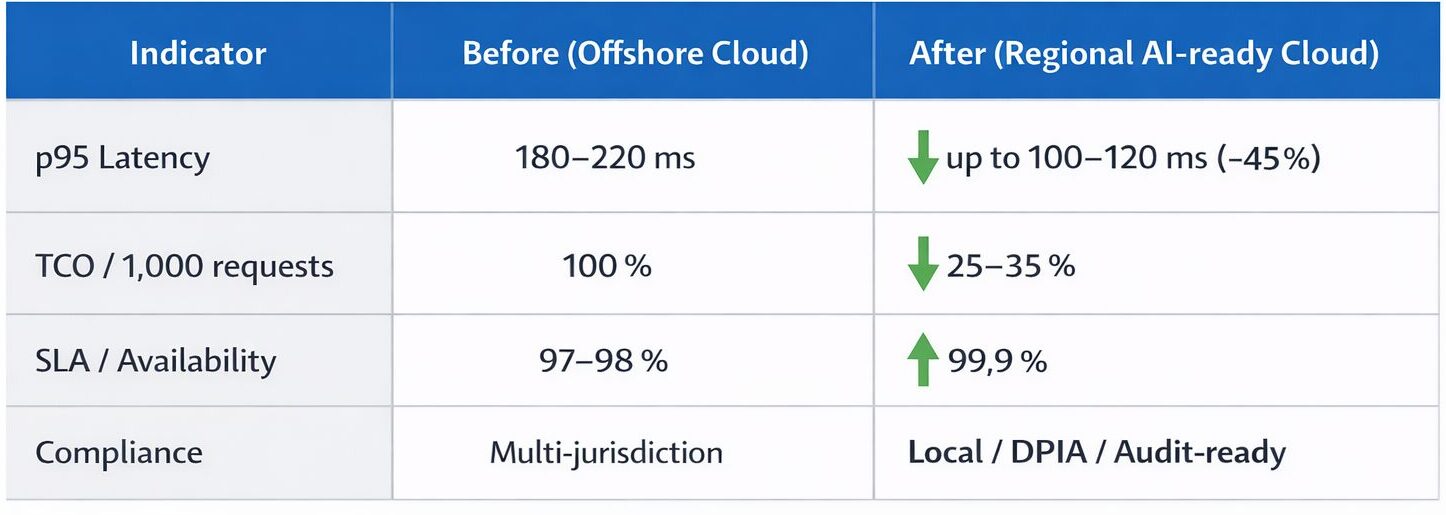
Indicative simulation based on public sector studies (GSMA, DatacenterDynamics, Uptime Institute, Microsoft/G42 Kenya).
Infrastructure: the invisible core of this shift
Behind every AI model lies a silent machinery: the infrastructure that makes everything possible. Without sovereign data centers, stable energy, or reliable interconnections, there is no robust AI pipeline, actionable data, or sustainable innovation.
This invisible foundation determines the speed, security and sovereignty of African digital ecosystems.
Regional actors like STELLARIX translate sovereignty ambitions into concrete capabilities by bringing data, compute and use cases together in trusted environments.
Practically, this means:
- 100% local hosting: colocation and regional cloud ensure data residency and proximity
- Multi-operator interconnection: smooth exchanges between clouds, companies, and universities
- Integrated security and compliance: encryption, logs, local erasure, audits
- Continuous operations (Run/MLOps): 24/7 monitoring, low-carbon energy supervision, service continuity
These local infrastructures are the true architects of Africa’s digital future, enabling the continent to not only host data but host its own intelligence.
Towards an African data economy
A new economy is emerging: data as Africa’s primary sovereign resource. From collection to hosting, governance to model training, each link in this chain now creates local value.
Africa is no longer just a digital market; it is a territory producing intelligence.
This transformation brings tangible effects:
- Skilled jobs through growing demand for data, MLOps, cybersecurity and governance roles
- Sovereign revenue from monetizing public and private datasets regionally
- Fairer partnerships with global platforms, enabled by common frameworks like SATA (Smart Africa Trust Alliance) and the Single Digital Market (SDM), strengthening African bargaining power
This momentum is already visible: according to African Business (From Strategy to Sovereignty: Crafting Africa’s AI Future, Oct 13, 2025), investments in African digital infrastructure could generate over 10 million direct and indirect jobs by 2030, while creating a locally capitalized innovation ecosystem.
By making data usable, measurable and profitable, Africa is building not just digital infrastructure, but a knowledge economy capable of competing globally.
From consumer to provider of intelligence
Africa is changing its role. Yesterday, the continent consumed technologies built elsewhere. Today, it feeds the world’s algorithms with its own data, models and talent.
In this new equation:
- Local datasets correct biases and give meaning to global models
- AI-ready data centers ensure speed, compliance, and sustainability
- AI communities (Masakhane, Zindi) and public policies (C4IR, PAP, SATA/SDM) structure a coherent continental ecosystem
Africa is no longer a passive recipient of technology: it is exporting its intelligence, grounded in local realities, connected to its territories, and looking to the future.
Related articles
- Read the article : Data Sovereignty: The Foundation of Truly Useful AI for Africa
- Read the article : Regional Data Centers & African AI: Local Hosting That Boosts Performance and Sovereignty
- Read the article : From telecoms to cloud, then AI: Africa’s leap forward
Key takeaways
- Africa is becoming a provider of intelligence: local datasets correct bias and improve global models.
- The winning trio: African datasets + AI-ready data centers + SATA/SDM frameworks.
- Business first: latency ↓, TCO ↓, compliance ↑ → faster time-to-value.
Looking to bring your data, clouds, and use cases closer together?
Our regional experts support you in designing a sovereign, high-performance and sustainable architecture, tailored to on-the-ground realities.